Monday, March 5, 2012
Home Page
On August 6th, 1945, the United States dropped the first atomic bomb on Hiroshima at the close of World War II. The United States President, Harry Truman and the Prime Minister, Winston Churchill presented the Empire of Japan with an ultimatum. This ultimatum stated that, if Japan refused to surrender, it would face "prompt and utter destruction". After no reply from the Japanese for a couple of days, the United States made the decision to drop the second atomic bomb. This time they dropped it on Nagasaki, Japan. The immediate effects of the bomb killed 90,000-166,000 people in Hiroshima and 60,000-80,000 in Nagasaki. After months went by, people began to die due to burns, radiation sickness and other illnesses. In both cities, most of the deaths were civilians, even though signficant military casualities were taken as well. Ever since this significant event in history, people have been in huge controversy over the justification of this catastrophe. In our personal opinon, The united states was unjustified in dropping the bombs on Japan because the number of people killed from the blasts and the subsequent damages that followed far exceeds any mission that may have been accomplished by this type of annihilation.

History of the Event
The necessity of utilizing an atomic bomb in World War II is and will always be under considerable debate among historians. In World War II, people saw the complete mobilization of economies and entire populations. Both sides fought with grim determination and carried out acts of brutality in the hopes of achieving victory.

Prelude to the Bomb: April 1, 1945. Allies invaded the southern Japanese island of Okinawa. The surrender of Okinawa lead to the collapse of the Japanese cabinet. The Japanese military, determined and motivated, refused to allow negotiations with the Allies. They insisted on maintaing strict terms. For the Americans, this meant war. On July 16th, the first successful test of the atomic bomb weapon took place. At this point, it was clear that the atomic bomb became a reality as a war weapon. The real question was whether the United States would use it to end the war or not. Some of the leaders of the United States hypothesized that the use of the atomic bomb would end the war without a need for invasion.
The Potsdam Declaration, issued by the Allied powers called for "unconditional surrender". The Japanese did not accept this Declaration despite the fact that the United States promised "complete destruction" of their military and homeland if they did not comply. Due to the following ten days of Japanese silence, the atomic bomb was dropped on the city of Hiroshima on August 6th.
Evidence
Restatement of my Thesis: The dropping of the atomic bombs on Japan was unjustified because the number of people killed from the blasts and the subsequent damages that followed far exceeds any mission that may have been accomplished by this type of annihilation.
The above link is an interview with Dr. Leo Szilard concerning his professional opinions about the dropping of the atomic bombs. Dr. Leo Szilard is a Hungarian-born physicist who helped President Roosevelt to launch the A-bomb project. However, after years went by he became a key figure among the scientists opposing use of the bomb. This article effectively supports our thesis statement because Dr. Szilard offers an alternative to the dropping of the bombs when he says, "There was no need to demand the unconditional surrender of Japan. If we had offered Japan the kind of peace treaty which we actually gaver her, we could have negotiated peace."
This article describes the entire reasoning behind the dropping of the bombs. It also includes an explanation of the process of decision-making that the United States faced. Although it addresses both sides of the argument, I believe it helps to address many key points in proving the bombings as being unjustified. They provide the readers with useful information that there is no substansive evidence that exists about the bombing being "necessary" to make Japan surrender. They stated that the Japanese had already attempted to sue for peace in July of 1945 and were only hesitant because they distrusted the terms of unconditional surrender that the Allies demanded. This article even adds that Japan was utterly destroyed by the war (before the bombing) and that the United States's blockades prevented the island from getting the necessary food to survive, much less maintain any type of threat against America.

This is an excerpt from the novel, Hiroshima (which was written by Dwight Eisenhower) that is most likely the strongest piece of evidence that the dropping of the bombs was unjust. In his novel he exposes the horrors of nuclear war from the perspective of actual people that lived who through it. It discusses the lives of six people that lived through the bombings and discusses the devastation and trepidation of World War II. This compassionate and moving document has become a classic "that stirs the conscience of humanity".


Similar to another website on this page, this link addresses both arguments of historians about the morals of bombing Japan. At the bottom of the page is an interview section where you can read about the opinions of several historians. The interviews that pertain to my argument are with Admiral William Leahy and General Dwight D. Eisenhower. They clearly state that dropping the atomic bombs on Japan is the biggest mistake the United States ever made.
This particular site brings up specific questions that help to narrow the moral controversies of this debatable subject. This site asks the questions: Were there alternative to the use of the weapons? If there were, what were they and how plausible are they in retrospect? Why were alternatives not pursued? This site also provides U.S. documents that help to shed light on the considerations that induced Japan's surrender. It mentions many credible scientists and leaders of the time period and their perspectives on why dropping the bombs were unethical.
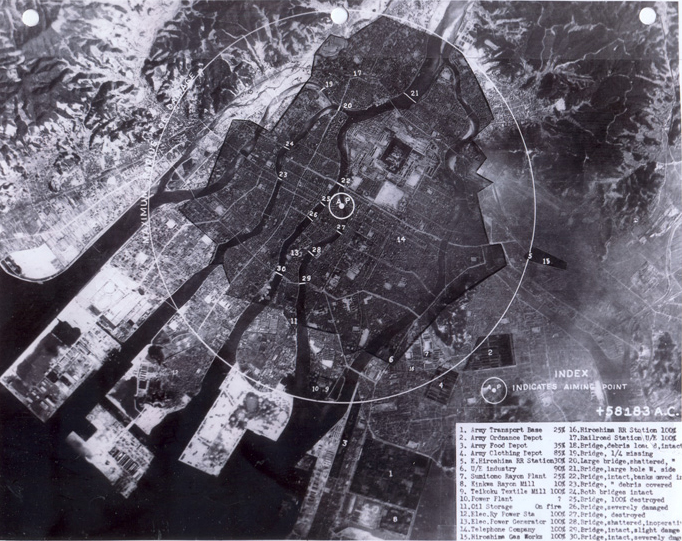 |
The total area devastated by the atomic strike on Hiroshima |
This is a very strong piece of evidence that we found while researching World War II. This interview is with a man that survived the bombings and talks about how he received a large dose of radiation from the bomb and suffered large consequences. He reveals that he can't think of anything productive that came from the Hiroshima bombing. He provides an interesting opinion on the interests of the United States on dropping the bomb. He believes that although the U.S. wanted to end the war, another reason for bombing Japan could be because they wanted to test the effects of their new atomic weapon.
Photo/Video Gallery
 |
Husband and wife scarred from the explosion |
 |
Damage caused in Hiroshima |
 |
Dead children in the hospital after the bombings |
 |
Burnt victim of the explosion |
 |
Young girl killed in Hiroshima |
 |
Horrifying picture of people found dead on the streets of Hiroshima |
This movie show the ruins of both cities in Japan and serve as evidence of the power of the explosion.
This video is specific to the destruction of Hiroshima. It shows the many buildings that were destroyed and how the Japanese culture was annihilated.
This footage is of the actual explosion of the city of Nagasaki. It shows the so called "mushroom cloud" from far away in an airplane.
Works Cited
Jennifer Rosenberg(1995). Hiroshima and Nagasaki http://history1900s.about.com/od/worldwarii/a/hiroshima.htm
David W. Koeller (1995). Bomb Dropped on Hiroshima, Webchron http://www.thenagain.info/webchron/world/hiroshima.html
Father Johannes Siemes (1996-2003). Atomic Bombing of Hiroshima, The War Time Journal http://www.wtj.com/archives/hiroshima.htm
Who Done It
Thesis: Cameron and Natalie
Introductory: Natalie
History of the Event: Natalie
Evidence: Natalie
Photo/Video Gallery: Natalie
Works Cited: Natalie
Subscribe to:
Posts (Atom)